

Community Peace Drives Output Surge as NNPCL Targets 2.5 Million Barrels Per Day in 2026
By Oriental News Staff
The Nigerian National Petroleum Company Limited (NNPCL) has attributed the recent improvement in crude oil output to sustained collaboration between host communities along the Trans Niger Pipeline (TNP) corridor and Pipeline Infrastructure Nigeria Limited (PINL), a development that is boosting national revenue and strengthening energy security.
This was disclosed by Engr. Akponime Omojevwhe, Head of Field Operations, Eastern Corridor, Project Monitoring Office (PMO) of NNPCL, during the January stakeholders’ meeting of host communities organised by PINL in Port Harcourt.
According to Omojevwhe, community cooperation has played a central role in improving crude oil evacuation and safeguarding the critical TNP asset.
“The message I was sent is to appreciate the stakeholders for your collaboration with PINL, which has shown a significant upshoot in oil production and has yielded revenue generation,” he said.
He urged communities to sustain the momentum in 2026, stressing that Nigeria’s oil output ambitions depend heavily on stable pipeline operations.
“I want to emphasise that this year, 2026, we must ensure it is better than 2025 so that our projection of 2.5 million barrels per day can be met,” Omojevwhe added.
Community Commitment Strengthens Pipeline Security
Earlier, Dr. Akpos Mezeh, General Manager, Community and Stakeholders Relations at PINL, revealed that host communities have renewed their commitment to preventing pipeline infractions, describing community buy-in as a major driver of performance.
“In this year 2026, we have gotten renewed commitments from the communities to ensure that there is no infraction on the pipelines,” Mezeh said.
He added that PINL remains fully aligned with the Federal Government’s ambition to raise national oil output to 2.5 million barrels per day.
“We are determined to achieve the Federal Government’s target of 2.5 million barrels per day production.”
Focus on Ogoniland Mediation
Mezeh further disclosed that PINL plans to intensify mediation efforts in Ogoniland to ease tensions and support the resumption of crude oil production in the area.
“Reaching the 2.5 million barrels per day target requires that we mediate in areas of conflict in the Niger Delta, and Ogoniland is key,” he stated.
He said the company’s 2026 strategy includes maintaining zero infractions on the TNP, deepening community intelligence, expanding women and youth empowerment initiatives, and strengthening collaboration with NNPCL, the Office of the National Security Adviser (ONSA), and security agencies.
Traditional Rulers and Youth Leaders Pledge Support
Representing ONSA, Mr. Young-Harry Amachree assured stakeholders that community concerns would be addressed, while traditional rulers commended PINL for its inclusive engagement model.
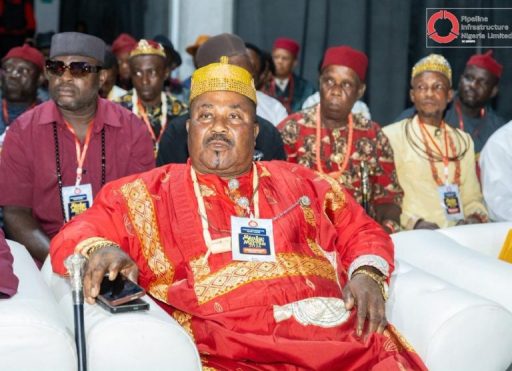
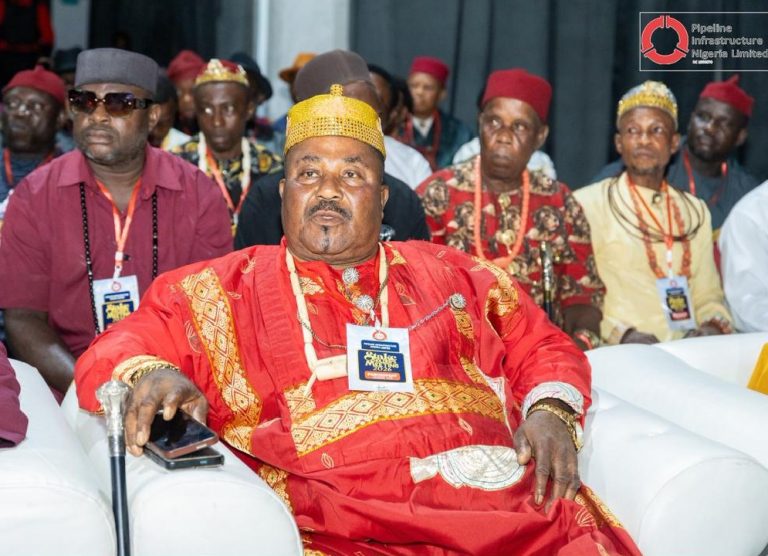
The King of Eleme Kingdom, HRM Dr. Philip Osaro Obele, praised the company for its commitment to community development and unity.
“They have carried everyone along. The recent distribution of palliatives showed that they recognise the communities and the work assigned to them,” he said.
Similarly, the King of Elele-Alimini Community, Eze Peter Wagbara, highlighted the company’s non-divisive operational style.
“So far, I have watched PINL in my domain, and there has not been any division,” he noted.
Youth leaders also pledged continued support, with Engr. Legborsi Yamaabana, spokesperson of the Niger Delta Ethnic Youth Leaders, urging the Federal Government to entrust PINL with greater responsibilities.
“They are part of us. We have adopted them as a vehicle for peace, development and economic growth,” Yamaabana said.
The growing collaboration between host communities, operators, and government agencies is increasingly seen as a critical factor in Nigeria’s drive to restore oil production, secure vital infrastructure, and meet its ambitious 2026 output targets.