

Two Delta Communities at Daggers Drawn Over Oil Field Ownership
By Naija Enquirer Staff
Leaders of Sapele Okpe community in Okpe Kingdom and Abigborodo community in Warri Kingdom of Delta State are locked in a dispute over the naming and ownership of a proposed oil field located within Petroleum Prospecting Licence (PPL) 220.
Both communities have advanced competing historical, legal and administrative claims over the oil field, escalating tensions in the area.
While leaders of Sapele Okpe have rejected the use of the name ‘Abigborodo Oil Field’, insisting that the land lies within Okpe territory, their counterparts in Warri Kingdom have maintained that the oil field was correctly named and that Abigborodo, in Warri North Local Government Area, is the rightful landowner.
Dispute Over EIA Submission
The disagreement followed an alleged submission by the Alema of Warri Kingdom, Chief Emmanuel Oritsejolomi Uduaghan, to the Federal Ministry of Environment, urging the ministry to disregard protests by the Udogun Okpe, the apex traditional authority of the Okpe Kingdom, over the Environmental Impact Assessment (EIA) public display for PPL 220.
Speaking on behalf of the Sapele Okpe community, their leaders cited archival records, colonial correspondence and a 2020 White Paper issued by the Delta State Government following a judicial panel of enquiry to support their claims.
They dismissed assertions that Chevron Nigeria Limited previously operated in the disputed area, stating that Chevron’s activities were confined strictly to Abigborodo territory and did not extend into Okpe land.
According to them, naming the oil field after Abigborodo amounts to an attempt to confer ownership without any legal foundation.
The leaders urged the Federal Ministry of Environment and the project operator, Navante Exploration and Production Limited, to ensure that the EIA process accurately identifies the rightful host community, warning that any errors could result in environmental injustice.
Warri Kingdom Responds
In his submission to the Ministry of Environment, the Alema of Warri, Chief Uduaghan, accused the Okpe leadership of presenting what he described as “half-truths and outright falsehoods,” insisting that historical and legal records support Abigborodo’s claim.
He stated that Abigborodo, Gbekoko and Otonyatsere are administered under the Warri Kingdom and fall under the overlordship of the Olu of Warri.
Chief Uduaghan further argued that Okpe authorities did not administer the Okpe Sobo Forest Reserve, citing archival documents which, according to him, show that Okpe representatives informed colonial administrators in 1931 that they had no land to contribute to the proposed forest reserve.
He also referenced subsequent colonial investigations, petitions by Abigborodo leaders and forest ordinances which he said led to excisions and boundary adjustments in favour of Abigborodo.
Protests and Counter-Protests
While defending the EIA public display, the Alema stressed that the exercise was environmental in nature and not intended to reopen land ownership disputes, adding that the naming of the oil field followed established industry practice.
Meanwhile, indigenes of Abigborodo have expressed concern over what they described as continued exclusion from benefits and employment opportunities associated with the operations of an indigenous oil company in the area.
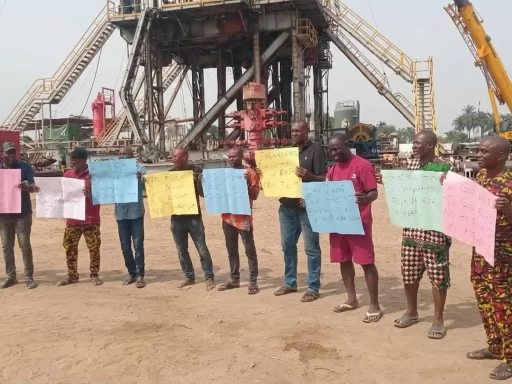
Protesters recently vowed to halt the company’s operations if their demands were not addressed.
However, a counter-protest was subsequently organised in Oton community, where demonstrators carried placards asserting that the oil company’s operational area falls within Oton land.
The competing protests underscore growing tensions around oil exploration, community ownership and benefit-sharing in Delta State.