

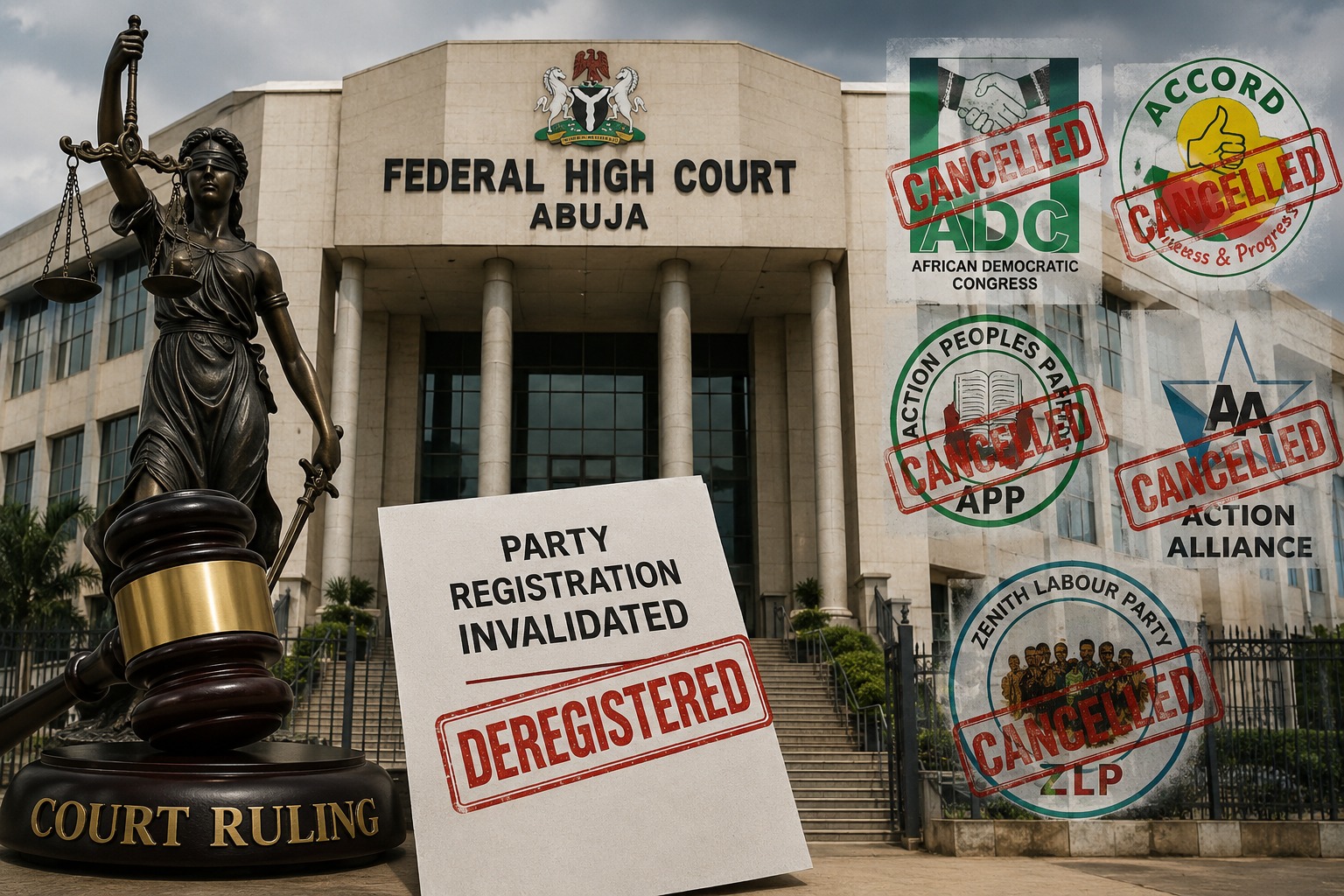

A Federal High Court ruling in Abuja that reportedly invalidated the African Democratic Congress (ADC), Accord Party, Action Peoples Party, Action Alliance and Zenith Labour Party has triggered widespread political reactions across Nigeria.
The decision, delivered by Justice Peter Lifu, has become a major flashpoint ahead of the 2027 general elections, with opposition figures warning that it could weaken Nigeria’s multiparty democratic system.
Opposition Leaders Reject Decision
Prominent political actors, including former Vice President Atiku Abubakar, Osun State Governor Ademola Adeleke, and ADC National Chairman Senator David Mark, have strongly criticised the ruling.
They argued that the judgment poses a threat to democratic competition and could shrink political space ahead of the next election cycle.
Atiku described the development as alarming, insisting that it undermines constitutional order and the principles of political freedom.
Governor Adeleke also faulted the ruling, warning that it could disrupt electoral participation and voter choice in affected states.
Case Origin and Court Orders in Dispute
The case was instituted by the National Forum of Former Legislators, which asked the court to determine whether INEC has the power to deregister political parties that fail to meet electoral performance thresholds under Section 225A of the Constitution.
The plaintiffs argued that the affected parties did not meet minimum requirements such as securing legislative seats or achieving significant vote shares in elections.
However, opposition parties insist that the ruling disregarded a prior order from the Court of Appeal that had stayed proceedings in the matter, raising questions about judicial procedure and hierarchy.
Atiku Raises Constitutional Concerns
Atiku, through his media aide, warned that the judgment raises serious legal and constitutional issues, particularly in light of the alleged subsisting appellate court order.
He argued that ignoring such an order undermines the rule of law and could set a dangerous precedent in Nigeria’s democratic process.
The former Vice President further alleged that opposition parties are facing coordinated pressure ahead of 2027, calling for vigilance from democratic institutions.
ADC, Others Vow Legal Challenge
The African Democratic Congress rejected the ruling, describing it as an attempt to weaken opposition structures and restrict political competition.
The party insisted that INEC had previously confirmed that it met all legal requirements for continued registration and said no constitutional basis exists for its deregistration.
It also warned that any attempt to exclude opposition parties from elections could destabilise the country’s democratic order.
Legal Experts and Party Stakeholders React
Political and legal stakeholders are divided over the judgment. While some urge calm and reliance on appeal processes, others argue that the ruling reflects deeper tensions in Nigeria’s political system.
The ADC leadership, including Senator David Mark, assured supporters that the decision will be challenged and overturned through higher courts.
Other party representatives also maintained that the matter must be resolved strictly through constitutional channels.
Growing Political Uncertainty Ahead of 2027
The controversy has intensified debate over party regulation, electoral thresholds, and the independence of the judiciary in political matters.
Observers say the ruling could reshape Nigeria’s party landscape if upheld, while critics warn it may deepen political mistrust and increase tensions ahead of the 2027 elections.